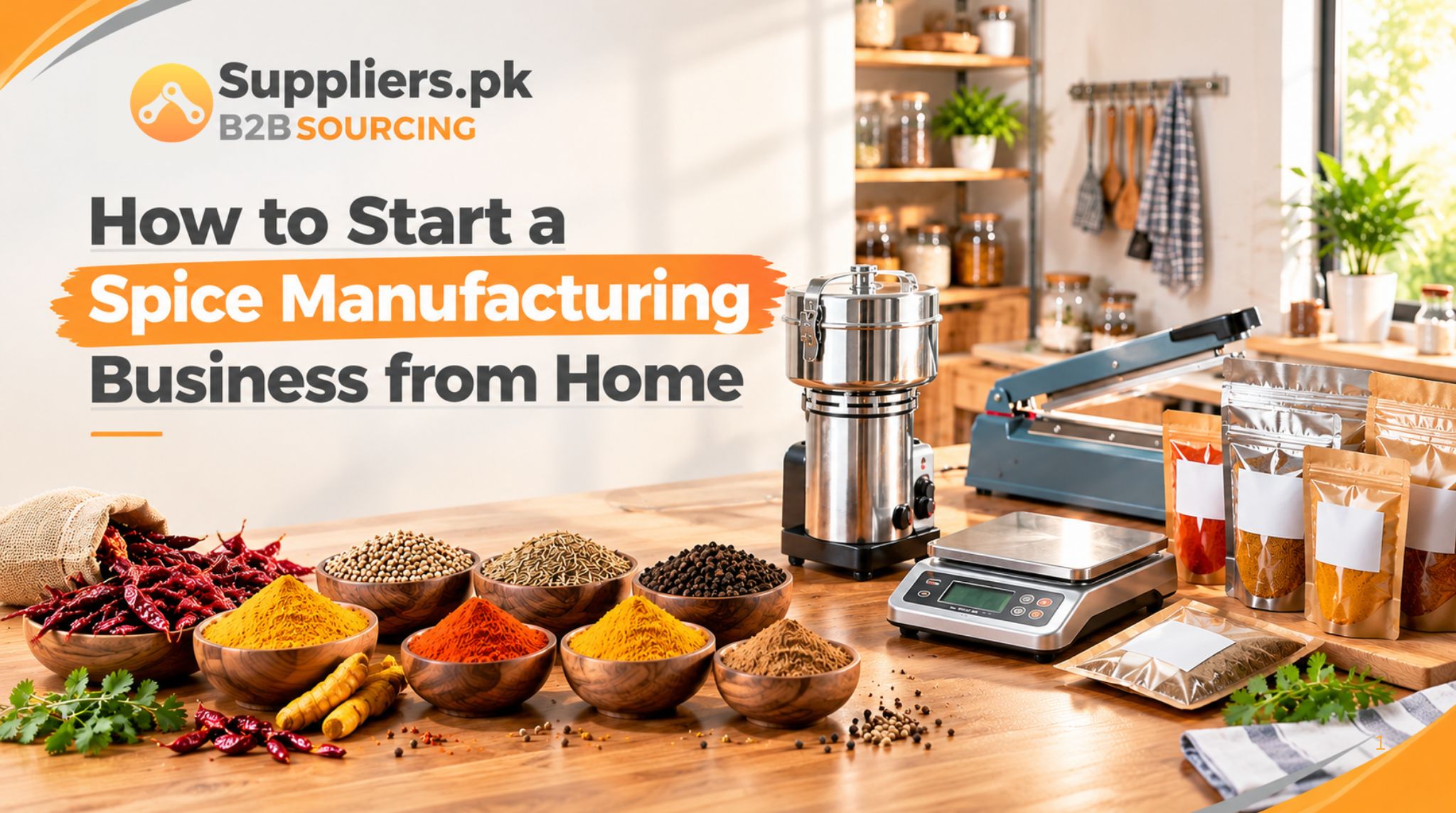
How to Start A Spice Manufacturing Business from Home
Suppliers Admin October 27, 2026
1. ABOUT THE BUSINESS:
Starting a home-based spice manufacturing business is a practical opportunity for entrepreneurs who want to enter the food industry with a relatively small investment. The business involves purchasing whole spices, cleaning and grinding them, blending different spices to create popular recipes, and packaging them under your own brand name.
You can start with everyday spices such as red chilli powder, turmeric powder, coriander powder, cumin powder, and black pepper. Later, you can introduce blended products such as biryani masala, karahi masala, tikka masala, and garam masala.Initially, production can be managed in a dedicated, clean room at home. As demand increases, the business can expand into a small commercial production unit.
2. ABOUT MACHINERY:
For small-scale home production, expensive industrial machinery is not necessary. You can begin with basic equipment and upgrade as sales grow.
The essential equipment includes:
Spice Grinder: A heavy-duty stainless-steel grinder suitable for processing dried spices. Estimated cost: PKR 25,000–60,000.
Digital Weighing Scale: For accurately measuring ingredients and filling packets. Estimated cost: PKR 2,000–5,000.
Heat Sealing Machine: For sealing plastic or laminated spice pouches. Estimated cost: PKR 5,000–12,000.
Stainless-Steel Sieves: For removing coarse particles and achieving consistent powder quality. Estimated cost: PKR 2,000–5,000.
Mixing Equipment: Food-grade containers and stainless-steel utensils for preparing spice blends. Estimated cost: PKR 3,000–8,000.
The total estimated machinery and equipment budget is PKR 37,000–90,000. Prices depend on quality, capacity, and supplier.
3. ABOUT RAW MATERIAL:
Raw materials are the foundation of a successful spice business. Purchase whole spices from reliable wholesale markets to maintain quality, freshness, and consistency.
Common raw materials include dried red chillies, turmeric fingers, coriander seeds, cumin seeds, black pepper, cinnamon, cloves, cardamom, and dried garlic.
For blended products, additional ingredients may include dried ginger, fennel seeds, and other food-grade spices according to the recipe.
Initially, purchase approximately 50–100 kg of mixed raw spices rather than large quantities of individual ingredients. This reduces storage requirements and minimizes the risk of stock becoming stale.
An initial raw-material budget of PKR 40,000–100,000 may be sufficient for a small operation, depending on the product range and prevailing wholesale prices.
Always inspect ingredients for moisture, mould, insects, foreign particles, and unusual odours. Store raw materials in airtight, food-grade containers in a cool, dry environment.
4. ABOUT PACKING AND PACKAGING SIZES:
Packaging protects the product from moisture, contamination, and loss of aroma while creating a professional brand image.
For a home-based business, laminated food-grade pouches are a practical and affordable option. Heat-sealable pouches provide better protection than ordinary thin plastic bags.
Recommended packaging sizes include:
25 grams: Trial packs and small quantities of premium spices.
50 grams: Small household packs.
100 grams: Standard retail packs for individual spices.
200 grams: Regular household-use packs.
400–500 grams: Family packs and bulk household purchases.
1 kilogram: Restaurants, caterers, and wholesale customers.
Start with 50 g, 100 g, and 200 g packaging to keep inventory manageable. Add larger sizes when customer demand justifies them.
Printed labels should include the brand name, product name, net weight, ingredients, manufacturing and expiry dates, batch number, storage instructions, and required regulatory information. Use only packaging approved for direct food contact.
5. ABOUT INVESTMENT:
The initial investment depends on whether you grind spices yourself or purchase ready-ground ingredients from approved suppliers.
A basic home-based setup may require:
Machinery and equipment: PKR 37,000–90,000.
Initial raw materials: PKR 40,000–100,000.
Packaging and labels: PKR 10,000–25,000.
Branding and marketing: PKR 5,000–15,000.
Hygiene supplies and miscellaneous expenses: PKR 8,000–20,000.
Estimated initial investment: PKR 100,000–250,000.
This estimate excludes major renovations, commercial rent, delivery vehicles, and significant regulatory or licensing expenses. Actual costs should be confirmed through local supplier quotations.
6. ABOUT RUNNING COST:
Monthly running costs include raw materials, packaging, electricity, transportation, marketing, and equipment maintenance.
For a small operation producing approximately 300–500 kg monthly, a preliminary budget could include PKR 100,000–250,000 for raw materials, PKR 15,000–35,000 for packaging, PKR 5,000–15,000 for utilities and hygiene, and PKR 10,000–30,000 for marketing and distribution.
Additional expenses may include delivery charges, damaged stock, retailer commissions, and hired labour.
Total monthly expenditure could range from PKR 130,000–350,000, depending on production volume and the product mix.
7. ABOUT PROFIT:
Profitability depends on purchasing costs, product quality, packaging, sales volume, and distribution margins.
For example, suppose a 100 g spice packet costs PKR 65 to manufacture and package. If it sells directly to customers for PKR 100, the gross contribution is PKR 35 per packet before delivery, marketing, overheads, and other expenses.
Selling 2,000 packets monthly would generate PKR 200,000 in revenue and PKR 70,000 in gross contribution. Actual net profit would be lower after operating expenses.
A small brand might initially achieve a net profit margin of approximately 5–15%, although results vary considerably. These figures are illustrative, not guaranteed returns.
8. ABOUT TARGET MARKET:
The primary target market includes households, grocery stores, neighborhood supermarkets, restaurants, caterers, food stalls, and small retailers.
Health-conscious customers may also be interested in products with clearly disclosed ingredients and no unnecessary additives, provided all claims are accurate and supported.
Initially, focus on a specific neighborhood or city area instead of attempting nationwide distribution. Build a reputation for freshness, consistent flavor, hygienic production, and reliable delivery.
9. MARKETING AND SALES STRATEGY:
Begin by creating a professional brand name, logo, product labels, and attractive product photographs. Offer introductory sample packs to friends, family, and potential customers to collect genuine feedback.
Use WhatsApp Business to display your catalogue, prices, package sizes, and ordering details. Promote products through Instagram, Facebook, TikTok, and local community groups.
Approach nearby grocery stores and mini-marts with samples and a clear wholesale price list. Offer reasonable retailer margins while ensuring that your own costs remain covered.
Contact restaurants and caterers to introduce larger packs of frequently used spices. Encourage repeat orders through consistent quality, responsive customer service, and convenient delivery.
Track sales, customer feedback, and the profitability of every product. Initially, focus on five to eight popular spices rather than launching too many products simultaneously.
Before commercial production, confirm the applicable food-business registration, licensing, labelling, and home-production requirements with the relevant provincial food authority. In Pakistan, these requirements vary by province and product category.
The best strategy is to start small, maintain strict hygiene, test demand, and reinvest profits into better equipment and wider distribution.
Written by: Dr. Fatima
Looking for Spice Processing Machinery Suppliers?
If you are planning to start a spice manufacturing business from home and need reliable suppliers for raw whole spices, industrial grinders, pulverizers, heat-sealing machines, or printed packaging materials, visit Suppliers.pk to find trusted suppliers or get in touch with us directly!
Contact Us:
- 🌐 Website: www.suppliers.pk
- 📧 Email: info@suppliers.pk
- 📞 WhatsApp / Phone: +92 300-8270451
- 📍 Location: Karachi, Pakistan.
#spicemanufacturing #spicegrinding #pakistanispices #smallscaleindustry #homebasedbusiness #foodprocessing #spicestartup #packagingmachinery #spicesofpakistan #homebusinessideas #supplierspk #b2bsourcing #madeinpakistan #b2bmarketplace #pakistanbusiness #scspakistan #suppliernetwork #wholesale #digitalpakistan #businessgrowth