How to Start a Mayonnaise Manufacturing Business from Home
Marketing November 1, 2026
1. ABOUT THE BUSINESS
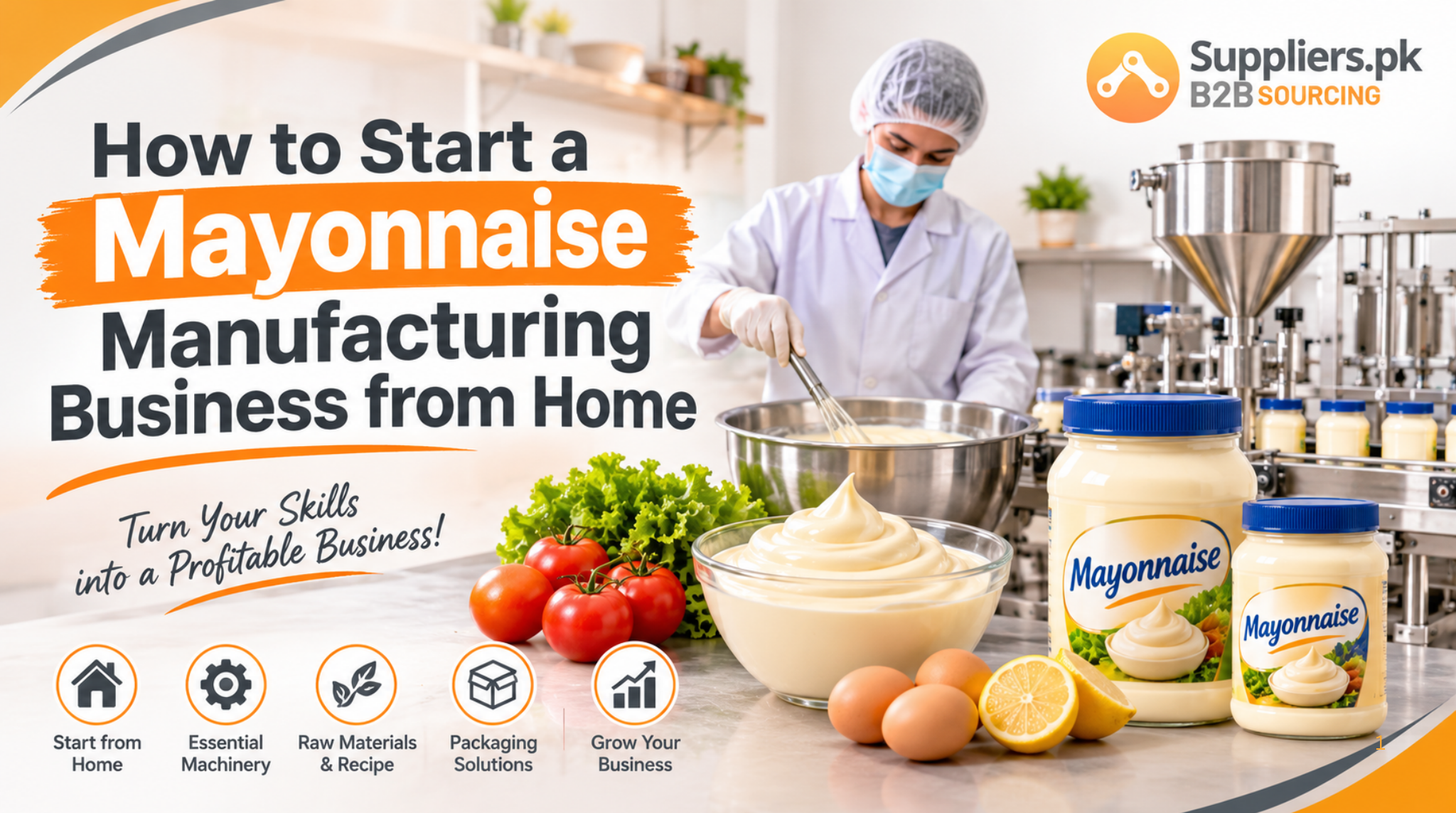
Mayonnaise manufacturing is a promising food business because mayonnaise is widely used in burgers, sandwiches, shawarmas, wraps, salads, and fast-food meals. Restaurants, cafés, home-based food businesses, and households regularly purchase mayonnaise, creating opportunities for small manufacturers to establish their own brands.
A home-based business can begin with a limited product range, such as classic mayonnaise, garlic mayonnaise, spicy mayonnaise, and sandwich spreads. Initially, production can focus on supplying nearby restaurants, burger shops, cafés, and retail customers.
However, mayonnaise is a perishable, emulsion-based food that requires strict hygiene, validated food-safety controls, and reliable storage. Commercial production should only begin after confirming the applicable food-business licensing, formulation, shelf-life, and labelling requirements. A dedicated, hygienic production area is preferable to an ordinary home kitchen.
2. ABOUT MACHINERY
Small-scale mayonnaise production requires equipment capable of mixing ingredients thoroughly and creating a stable emulsion.
Essential equipment includes:
High-Speed Mixer or Emulsifier: Produces a smooth, uniform mayonnaise texture. Estimated cost: PKR 40,000–120,000.
Stainless-Steel Mixing Containers: Food-grade vessels for preparing batches. Estimated cost: PKR 15,000–40,000.
Digital Weighing Scales: Ensure accurate ingredient measurements. Estimated cost: PKR 3,000–8,000.
Filling Machine: Helps fill bottles or jars consistently. A basic semi-automatic unit may cost PKR 40,000–120,000.
Bottle Sealing Equipment: Supports secure packaging and tamper evidence. Estimated cost: PKR 10,000–30,000.
Refrigeration and Temperature Monitoring: Appropriate for ingredients and products when required by the validated process.
A small setup may require approximately PKR 108,000–318,000 for basic equipment. These are preliminary estimates; industrial emulsifiers, automated filling lines, and specialized food-processing systems can cost substantially more.
3. ABOUT RAW MATERIAL
The main ingredients depend on the product formulation and whether the mayonnaise is egg-based or egg-free.
Typical ingredients include refined vegetable oil, pasteurized egg yolk or an appropriate egg-derived ingredient, vinegar or another suitable acidifying ingredient, salt, sugar, mustard, and permitted stabilizers where required.
Egg-free mayonnaise generally uses suitable plant-based ingredients and emulsifiers to create the desired texture. Garlic, chili, herbs, and other flavorings can be added to develop specialty varieties.
Ingredient quality directly affects taste, consistency, and stability. Purchase food-grade ingredients from reliable suppliers and maintain batch records.
Food safety is essential: ordinary homemade mayonnaise recipes should not automatically be assumed suitable for commercial sale. The formulation, acidity, microbial safety, processing method, and shelf life must be professionally validated. Use pasteurized egg ingredients where applicable, and never claim a product is shelf-stable without appropriate testing.
4. ABOUT PACKING AND PACKAGING SIZES
Packaging should protect mayonnaise from contamination, leakage, and deterioration while providing convenience for different customers.
Recommended sizes include:
20–30 grams: Single-serving sachets for takeaway meals and food delivery orders.
100 grams: Trial packs and individual household use.
200–250 grams: Small family packs.
400–500 grams: Standard household packs.
1 kilogram: Restaurants, cafés, burger shops, and catering businesses.
3–5 kilograms: High-volume commercial kitchens, subject to appropriate packaging and storage requirements.
Food-grade plastic squeeze bottles, suitable jars, and approved sachet packaging are common options. Small manufacturers can initially focus on 250 g, 500 g, and 1 kg packs to simplify production.
Labels should include the brand name, ingredients, net weight, allergen declarations, batch number, manufacturing and expiry dates, storage instructions, and applicable regulatory information.
Packaging costs depend on material, printing, order quantity, and supplier. Obtain quotations before finalizing retail prices.
5. ABOUT INVESTMENT
A small mayonnaise manufacturing setup requires investment in equipment, ingredients, packaging, hygiene, and workspace preparation.
An illustrative initial budget includes:
Machinery and equipment: PKR 108,000–318,000.
Initial raw materials: PKR 50,000–100,000.
Bottles, caps, labels, and packaging: PKR 20,000–50,000.
Hygiene supplies and workspace preparation: PKR 30,000–80,000.
Branding and initial marketing: PKR 10,000–25,000.
Estimated initial investment: PKR 218,000–573,000.
This estimate excludes rent deposits, major renovations, professional laboratory testing, licensing fees, and additional working capital. Actual investment depends on production capacity and regulatory requirements.
6. ABOUT RUNNING COST
Monthly running expenses include oil, egg ingredients or plant-based alternatives, vinegar, seasonings, packaging, electricity, refrigeration, transportation, marketing, and labor.
For a small operation producing approximately 300–500 kg monthly, a preliminary operating budget might range from PKR 250,000 to PKR 600,000. Ingredient prices and packaging choices can significantly affect this amount.
Additional expenses may include laboratory testing, equipment maintenance, rejected batches, retailer commissions, and delivery costs.
Accurate production records are essential for monitoring ingredient consumption, wastage, and the cost per kilogram.
7. ABOUT PROFIT
Profit depends on ingredient costs, formulation, packaging, sales volume, and distribution margins.
For example, suppose a 500 g bottle costs PKR 180 to manufacture and package. If it sells directly to customers for PKR 260, the gross contribution is PKR 80 per bottle before delivery, marketing, rent, labor, and other overheads.
Selling 1,000 bottles would generate PKR 260,000 in revenue and PKR 80,000 in gross contribution. Net profit would be lower after operating expenses.
These figures are illustrative, not verified market quotations. Actual selling prices and margins should be calculated using current supplier prices and competitor research.
8. ABOUT TARGET MARKET
Potential customers include households, grocery stores, supermarkets, restaurants, cafés, burger shops, shawarma outlets, sandwich businesses, caterers, and cloud kitchens.
Food-service businesses can be particularly valuable customers because they may purchase mayonnaise regularly in larger quantities. Retail customers, meanwhile, can help build brand recognition.
Start locally and prioritize customers who value consistent taste, reliable supply, competitive pricing, and hygienic production.
9. MARKETING AND SALES STRATEGY
Create a recognizable brand name, professional label, and attractive product catalogue. Use WhatsApp Business, Facebook, Instagram, and TikTok to display products, packaging sizes, prices, and ordering information.
Approach nearby restaurants, burger shops, cafés, and caterers with samples and wholesale quotations. Offer suitable bulk packaging and dependable delivery schedules to encourage repeat orders.
For retail sales, approach neighborhood grocery stores and supermarkets, providing clear pricing and reasonable retailer margins.
Differentiate the brand through consistent flavor, quality ingredients, transparent labelling, and reliable customer service. Collect genuine feedback and introduce garlic, spicy, or egg-free variants only after establishing demand.
Before selling, obtain the relevant provincial food authority approvals and ensure the product meets applicable food-safety, labelling, testing, and shelf-life requirements.
The best strategy is to begin with a small, carefully controlled product range, validate demand, maintain strict food safety, and expand production as repeat orders increase.
Written by Dr. Fatima
Looking for Processing & Packaging Suppliers?
Agar aap mayonnaise manufacturing business start karna chahte hain aur raw materials, high-speed emulsifiers, stainless-steel mixing containers, bottle filling machines, ya custom food-grade packaging ke liye reliable suppliers dhondna chahte hain, toh Suppliers.pk par visit karein ya hum se direct rabta karein!
Contact Us:
- 🌐 Website: www.suppliers.pk
- 📧 Email: info@suppliers.pk
- 📞 WhatsApp / Phone: +92 300-8270451
- 📍 Location: Karachi, Pakistan
#mayonnaisemanufacturing #foodprocessing #saucesbusiness #homebasedbusiness #smallscaleindustry #pakistanfoodindustry #foodpackaging #startupbusiness #homebusinessideas #commercialcooking
#supplierspk #b2bsourcing #madeinpakistan #b2bmarketplace #pakistanbusiness #scspakistan #suppliernetwork #wholesale #digitalpakistan #businessgrowth